
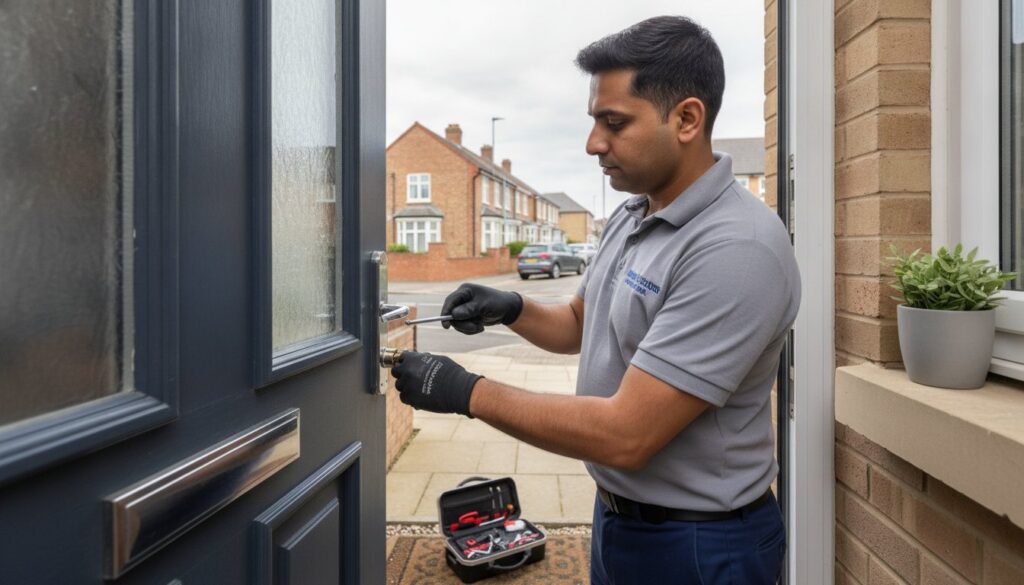
What if your home insurance policy was actually worthless because of a single piece of metal on your front door? It’s a sobering thought, but many residents don’t realise that failing to fit insurance approved locks in Leicester can void their cover entirely. You likely already feel that keeping your family safe is a top priority, especially with local concerns about rising burglary rates. However, trying to decipher the difference between BS3621 and the latest TS007 standards often feels like learning a second language.
We believe you deserve clear, no-nonsense advice rather than a confusing list of technical jargon. This guide provides a practical roadmap to securing your home whilst ensuring you meet strict UK insurance requirements. We’ll explain exactly what those Kitemark symbols mean for your specific door type and provide a straightforward checklist so you can audit your own security with confidence. By the time you’ve finished reading, you’ll know exactly how to upgrade your property and ensure your insurance remains valid.
Key Takeaways
- Understand why failing to install insurance approved locks in Leicester could lead to a rejected claim and how to identify the British Standard Kitemark on your hardware.
- Learn the critical differences between BS3621 for timber doors and TS007 for uPVC or composite entrances to ensure you choose the right protection.
- Use our simple audit checklist to determine if your current locks meet the 5-lever or 3-star requirements demanded by most UK insurers.
- Discover why even the highest-rated lock requires a sturdy frame and a 2-star security handle to provide complete protection against modern burglary techniques.
- Find out how a professional security survey can spot hidden vulnerabilities that a DIY check might miss, keeping your home and insurance policy fully protected.
Why Insurance Approved Locks in Leicester are Essential
A locked door doesn’t always mean a secure home. For many residents, the distinction between a standard lock and the insurance approved locks Leicester insurers demand only becomes clear after a break-in. These approved locks are pieces of hardware that have undergone rigorous testing to meet specific British Standards. They are designed to resist common attack methods like drilling, picking, and snapping. Without them, your property is a softer target for local thieves who know exactly which hardware is easiest to bypass.
Most UK home insurance policies contain a “Minimum Security Requirement” clause. This isn’t just small print; it is a binding agreement. If your home doesn’t meet these standards, your policy could be void. Understanding broader door security measures is helpful, but the lock remains the most critical component for compliance. Investing in a professional security upgrade in Leicester ensures your home isn’t just physically tougher to enter, but also legally protected should the worst happen.
The Financial Impact of Non-Compliance
Insurers use lock standards to calculate your premiums and, more importantly, to decide if they’ll pay out after a theft. There is a massive difference between a door being “locked” and being “securely locked to British Standards.” If a burglar enters through a non-compliant lock, a loss adjuster may argue that you failed to maintain the security level promised in your contract. Many homeowners assume that because their uPVC door is modern, it’s automatically compliant. This is a common pitfall that can lead to thousands of pounds in lost claims whilst leaving your family vulnerable. For a comprehensive overview of how to protect your property and stay compliant, our residential locksmith Leicester complete home security reference covers everything from lock upgrades to insurance requirements in detail.
Recognising the Kitemark Symbol
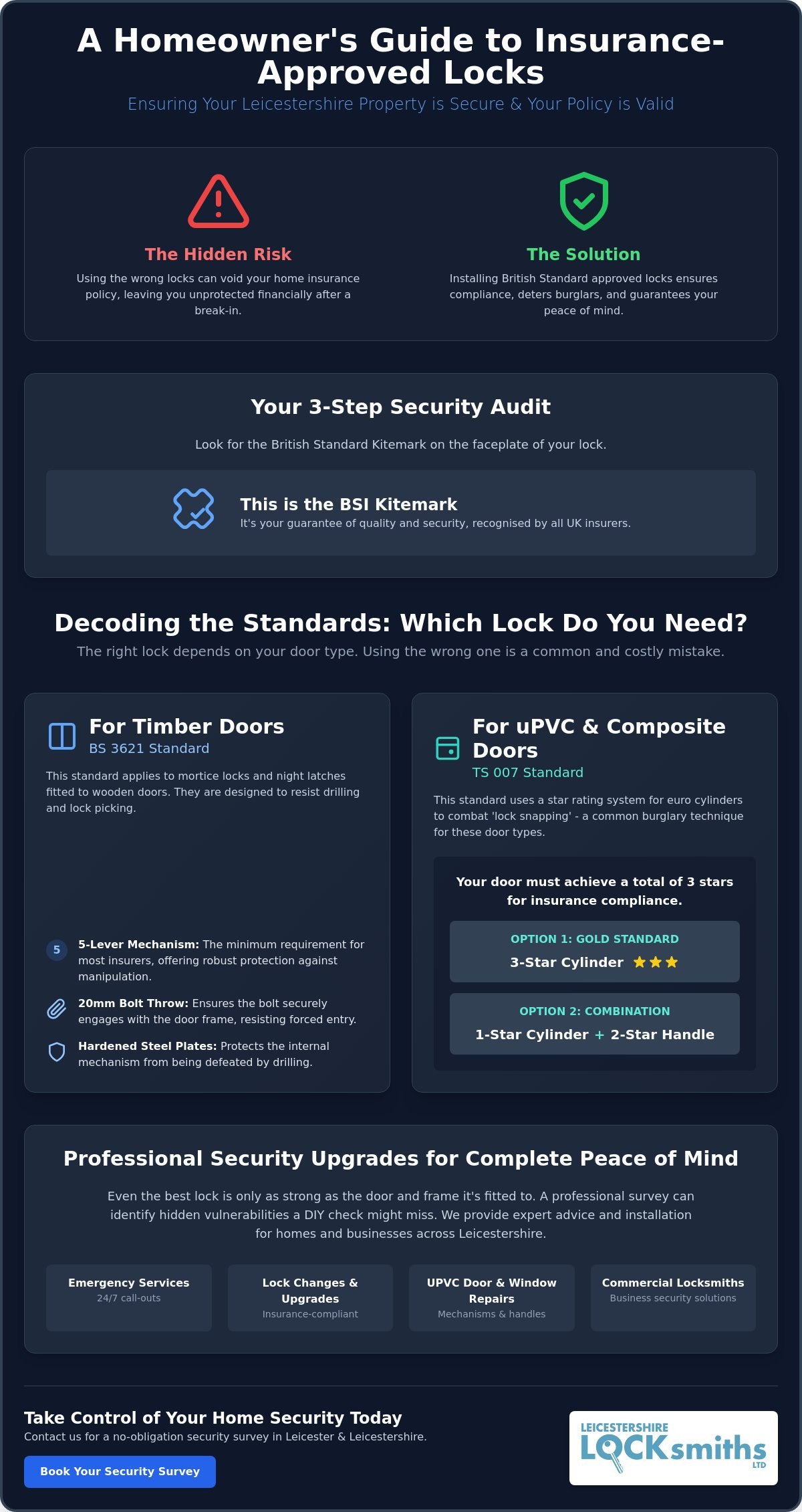
The easiest way to check your hardware is to look for the BSI Kitemark. This heart-shaped symbol is usually stamped directly onto the faceplate of a mortice lock or the side of a cylinder. It’s the first thing an insurance professional looks for during an inspection. You should also be careful with wording on product packaging. Hardware that is merely “tested to” a standard hasn’t necessarily passed the certification process. You need locks that are fully “approved” to ensure they provide the durability and resistance required for modern home protection.
Decoding the Standards: BS3621 vs TS007
Choosing the right hardware depends entirely on the material of your door. A common mistake we see across Leicestershire is homeowners trying to apply timber door standards to uPVC frames, which simply doesn’t work. To ensure you have insurance approved locks Leicester providers accept, you must match the specific British Standard to your door type. Using the wrong standard is often just as risky as having no security at all, as it can lead to a rejected claim if the hardware fails during a break-in.
BS3621 Mortice Locks for Timber Doors
Timber doors require locks that meet BS 3621:2017 standards. These are typically mortice locks or rim “night latches.” Insurers insist on a minimum of 5 levers because this design is significantly harder for a thief to pick or manipulate. These locks feature hardened steel plates to resist drilling and a sturdy bolt that throws at least 20mm into the door frame. You can check your own door by looking at the faceplate when it’s open. If you don’t see the Kitemark and “BS3621” engraved there, your timber door likely isn’t compliant with your policy.
TS007 Euro Cylinders for uPVC and Composite Doors
Modern uPVC and composite doors use euro cylinders, which follow the TS007 standard. This system uses a star rating to indicate security levels. To meet the requirements for British Standard locks in Leicester, your door needs to achieve a total of three stars. You can reach this threshold in two ways. You can fit a single 3-star rated cylinder, or you can combine a 1-star cylinder with a 2-star security handle. 3-star cylinders are the gold standard for anti-snap protection. They are specifically engineered to remain secure even if the outer part of the lock is snapped off by a burglar.
For the highest level of cylinder security, some homeowners opt for the SS312 Diamond standard. This is a Sold Secure rating that provides even greater resistance to professional attack methods than the standard 3-star cylinder. If you aren’t sure which rating your current cylinders have, it’s a good idea to ask a local expert to inspect your hardware. This simple check ensures you haven’t accidentally left a gap in your home’s defences that a thief could exploit.
Checking your home for insurance compliance shouldn’t be a guessing game. Many residents assume that just because they turn a key and the door stays shut, their property is fully protected. To truly secure your home and satisfy your provider, you need to physically verify that you have fitted insurance approved locks Leicester insurers recognise. This checklist allows you to walk through your property and identify any weak links that could lead to a rejected claim or a successful break-in.
Step 1: The Front and Back Door Audit
Your main entrance and any secondary back doors are the primary focus for any insurance loss adjuster. Open the door and look at the metal strip (the faceplate) running down the side. You are looking for the engraved BSI Kitemark and the specific standard number, such as BS3621:2017. If your door uses a cylinder, look at how far it sticks out from the handle. A cylinder that protrudes more than 3mm from the handle face is a major security risk, as it’s far easier for a thief to grip and snap. Finally, turn the key whilst the door is open to see the bolt. It should throw at least 20mm into the frame. When you close the door, the bolt must engage fully and smoothly without you having to force or “jiggle” the handle, as a partial engagement can void your cover.
Step 2: Window and Sliding Door Verification
Windows are often overlooked, yet they are a common entry point for opportunistic thieves. Check every ground-floor window and any upper-floor windows that are easily accessible, such as those above a flat roof or near a drainpipe. These must have key-operated handles to meet standard insurance requirements. If you’ve had uPVC window repairs in the past, ensure the new handles haven’t replaced locking versions with non-locking alternatives. Sliding patio doors require even more attention. Ensure they are fitted with anti-lift devices that prevent the doors from being lifted off their tracks from the outside. For many older sets, standard locks aren’t enough, and you may need to invest in additional patio door security to stay compliant.
Don’t forget your outbuildings. If you store high-value items like electric bikes or expensive tools in a garage or shed, your insurer likely requires these to have the same level of security as your main home. A simple padlock rarely suffices for high-value cover. Verifying these points now takes only a few minutes but provides the peace of mind that your security upgrade meets professional standards and that your insurance policy remains a solid safety net for your Leicester home.
Beyond the Locks: Addressing Common Security Vulnerabilities
Even the highest grade of insurance approved locks Leicester homeowners can buy won’t protect a property if the surrounding structure is failing. A lock is only as strong as the frame it’s bolted into and the hinges that hold the door in place. We often see high-security hardware fitted to frames that are rotting or pulling away from the brickwork. In these cases, a burglar won’t bother with the lock; they’ll simply force the entire door set. Holistic security means looking at the door as a complete system, including the letterbox and spyholes.
The “lock snapping” epidemic remains a significant concern across Leicestershire. While we previously discussed 3-star cylinders, your door handles also play a vital role. If you have a 1-star cylinder, you must pair it with a 2-star security handle to reach the required insurance threshold. These handles act as physical armour, making it much harder for a thief to grip the cylinder with tools. Additionally, fitting a letterbox guard prevents “fishing,” a technique where thieves use long poles to grab car keys or reach the internal thumb-turn of your lock from the outside.
uPVC Door Alignment and Maintenance
Alignment is a critical but often ignored aspect of home security. If your uPVC door has dropped even slightly, the multi-point locking system won’t engage correctly. You might notice you have to lift the handle with extra force or “jiggle” the key to get it to turn. This isn’t just an inconvenience; it’s a sign of imminent lock failure. Forcing a misaligned door puts immense pressure on the internal gearbox, which can eventually snap and leave you locked out or, worse, unable to secure the door at all. Seeking professional uPVC door repairs in Leicester is the best way to ensure your door remains functional and your insurance stays valid.
Garage and Outbuilding Protection
Garages and sheds are frequently the weakest links in a property’s defences. Most standard garage “T-bar” locks are incredibly easy to bypass with basic tools. If you store expensive tools, lawnmowers, or bicycles, you should consider a significant upgrade. Adding garage door bolts or a “defender” unit that bolts into the concrete floor provides a much more formidable deterrent. You can find more specific advice in our guide on garage and shed security in Leicester to ensure your outbuildings aren’t left vulnerable.
If you’re worried that your current setup has hidden weaknesses, it’s time to take action. You can book a professional security audit today to identify and fix these vulnerabilities before they are exploited.
Professional Security Upgrades: Next Steps for Peace of Mind
While the physical audit described in previous sections is a vital first step, a DIY check cannot replace the trained eye of a specialist. A professional security survey identifies the subtle signs of hardware fatigue or structural frame failure that often go unnoticed. By choosing a professional installation of insurance approved locks Leicester residents can be certain that their property isn’t just “locked” but truly fortified. Leicestershire Locksmiths Limited takes the guesswork out of compliance, ensuring that every bolt and cylinder meets the exact criteria your insurer demands for a valid policy.
This proactive approach offers significant long-term value. Beyond immediate physical protection, high-security hardware can positively impact your financial standing, as some providers offer reduced premiums once they’ve verified that your home exceeds their minimum requirements. We understand that your time is valuable, which is why we offer a 24/7 service. Whether you’ve just moved or want to upgrade your current defences, we can schedule a visit at a time that suits your lifestyle, including evenings and weekends.
What to Expect from a Professional Lock Change
When you book a lock change in Leicester with our team, the process is thorough and transparent. We begin with a non-destructive assessment of your current hardware. We carry a vast range of British Standard parts on our vehicles, allowing us to complete most upgrades on the spot. Once the new system is fitted, we provide a full demonstration, showing you how the mechanisms engage and how to maintain them correctly. This ensures you’re never left struggling with a stiff handle or a complex multi-point system.
Trusted Local Expertise Across Leicestershire
We’ve spent years building a reputation for reliability across the entire county. From the terraced streets of the Leicester City Centre to the leafy avenues of Oadby and Wigston, we know the local landscape intimately. This regional expertise is crucial because burglary trends vary by area; what works for a city apartment might not be the best solution for a detached home. We use this knowledge to provide tailored advice that addresses real-world risks in your specific neighbourhood. Our goal is to act as your calm guide, offering steady advice and immediate action. If you’d like to explore the full range of services available to homeowners, our residential locksmith Leicester home security reference guide provides detailed guidance on every aspect of protecting your property.
Don’t wait for a security breach to find out your locks aren’t up to scratch. Contact Leicestershire Locksmiths Limited today for a free security quote and let our experienced team give your home the professional protection it deserves.
Take Control of Your Home Security Today
Ensuring your property is fully protected starts with a clear understanding of the specific standards your insurer expects. By matching the right hardware to your door type, you remove the risk of a rejected claim. Whether you need a simple lock change or complex uPVC door repairs to restore alignment, taking proactive steps now prevents the stress and financial loss that often follow a break-in. We provide comprehensive support for both residential and commercial locksmith work, ensuring Leicester businesses are held to the same high standards of protection as local homes.
If you are unsure whether your current setup meets the necessary criteria for insurance approved locks Leicester, our team is ready to assist. We offer rapid emergency locksmith services across the county, specialising in non-destructive entry and professional fittings that meet strict BS3621 or TS007 requirements. Contact Leicestershire Locksmiths today for a professional security upgrade. Protecting the local community is our priority, and we are here to help you fortify your property with the expertise it deserves.
Frequently Asked Questions
What does “insurance approved locks” actually mean for a UK homeowner?
It means the hardware has been rigorously tested and certified to meet specific British Standards, such as BS3621 for timber doors or TS007 for uPVC. These certifications ensure the lock can resist common attack methods like picking, drilling, and snapping. Most UK insurance providers mandate these standards as a minimum requirement for your policy to remain valid during a claim. It’s the baseline for professional home security.
How do I know if my current mortice lock is BS3621 compliant?
You can identify a compliant lock by looking for the BSI Kitemark engraved on the faceplate of the lock. This heart-shaped symbol is usually accompanied by the standard number, such as BS3621:2017. If you only see a brand name without the Kitemark and the specific standard number, the lock likely doesn’t meet the thief-resistant requirements demanded by most modern insurance policies.
Will my insurance be void if I do not have a 5-lever lock?
Yes, your claim could be rejected if your policy specifies a 5-lever BS3621 lock and you have a lower grade fitted. Insurers view the 5-lever mortice lock as the minimum security standard for external timber doors. If a break-in occurs through a non-compliant lock, the loss adjuster may argue that you failed to maintain the security level agreed upon in your insurance contract.
What is the difference between a 1-star and a 3-star cylinder?
A 3-star cylinder provides the highest level of anti-snap protection on its own, whereas a 1-star cylinder must be paired with a 2-star security handle to meet the same standard. The star rating follows the TS007 system for uPVC and composite doors. We recommend 3-star cylinders for the best defence, as they are engineered to remain locked even if the outer part is snapped off.
Do I need to change my locks when I move into a new house in Leicester?
We strongly advise changing your locks immediately when moving to a new property to ensure you are the only person with access. You don’t know how many spare keys are held by previous tenants, owners, or local tradespeople. It’s also a vital opportunity to install insurance approved locks Leicester insurers require, as the existing hardware may be outdated or fail to meet your new policy’s criteria.
Can I fit insurance approved locks myself or do I need a locksmith?
You can fit them yourself, but a professional installation ensures the lock is aligned perfectly and functions as intended. Poorly fitted locks often fail to engage correctly with the door frame, which can compromise security and potentially void your insurance. A professional locksmith provides the expertise to ensure the hardware is integrated seamlessly, offering a guarantee on both the parts and the workmanship for your peace of mind.
What should I do if my uPVC door lock is stiff or difficult to turn?
You should seek a professional repair immediately, as stiffness is a warning sign of a dropped door or a failing gearbox. Forcing a stiff handle puts immense pressure on the internal mechanisms, which will eventually lead to a total lock failure. Addressing the alignment early prevents an emergency lockout and ensures your door continues to provide the high level of security required by your insurance provider.
Are keyless smart locks insurance approved in the UK?
Some smart locks are approved, but they must meet specific standards like TS621 or be used in conjunction with a BS3621 mortice lock. You must check with your insurance provider before fitting one, as many smart locks don’t meet the physical attack resistance tests required in the UK. Using a non-approved electronic lock on an external door could leave your property vulnerable and your insurance policy completely void.