
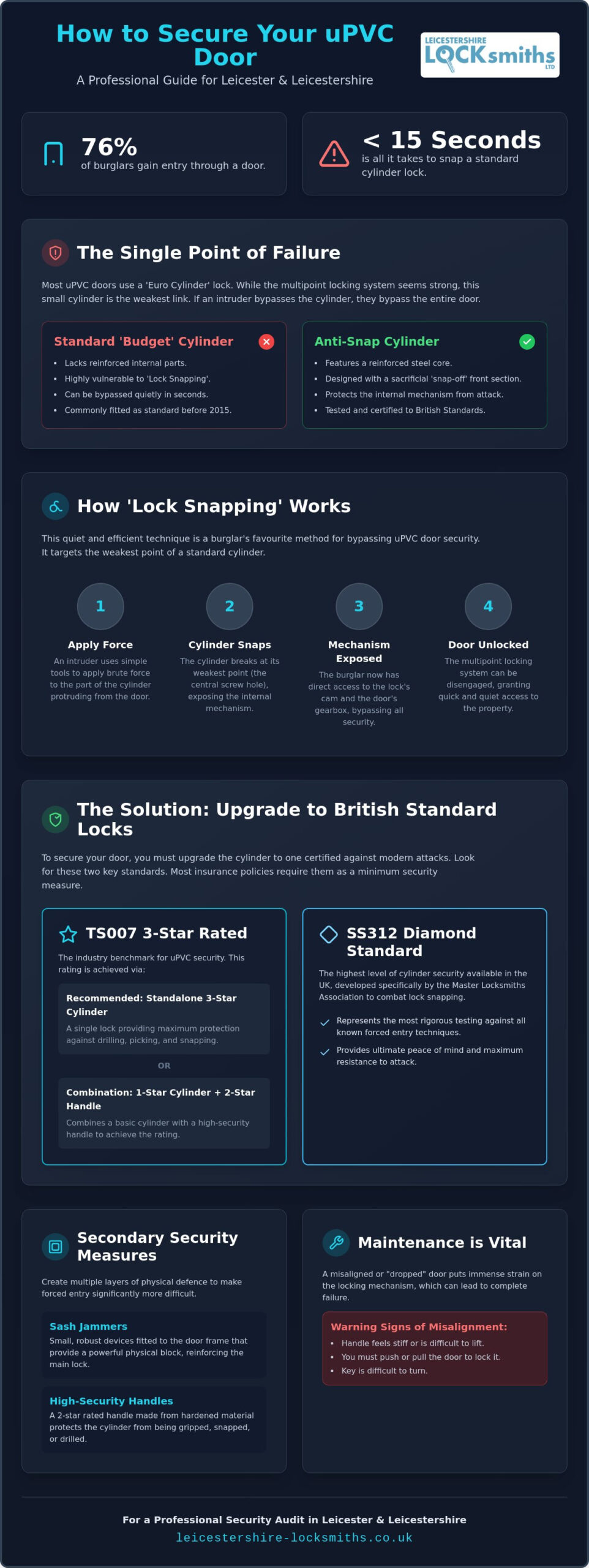
Did you know that 76% of burglars gain entry to a property through a door, and a standard euro cylinder lock can be snapped in under 15 seconds? For homeowners and business owners across Leicester, this is a worrying reality that demands professional attention. You likely chose your uPVC door for its durability, but if you’re currently battling a stiff handle or wondering if your hardware is outdated, you’re right to be concerned. Learning how to secure a uPVC door effectively is the best way for residents and local companies to regain peace of mind and protect their property from opportunistic crime.
It’s frustrating when technical jargon about British Standards makes security feel needlessly complicated. We believe that protecting your premises should be straightforward and stress-free. This guide will show you exactly how to upgrade your defences and ensure your locks are insurance-compliant, whether for a domestic or commercial setting. We’ll explore everything from the importance of SS312 Diamond rated anti-snap cylinders to the simple alignment tweaks that keep your multi-point locking system functioning perfectly for years to come.
Key Takeaways
- Learn how to identify the vulnerabilities of standard euro cylinders and why they are the primary target for intruders.
- Discover how to secure a uPVC door by upgrading to TS007 3-star or SS312 Diamond rated cylinders for maximum protection.
- Understand how secondary security measures like sash jammers and high-security handles create multiple layers of physical defence.
- Recognise the signs of a “dropped” door and why correct alignment is vital for the security of your locking mechanism.
- See how a professional security audit can help Leicester homeowners meet strict insurance standards and improve home safety.
Understanding uPVC Door Vulnerabilities: Why Standard Locks Fail
Most uPVC doors across Leicestershire rely on a component called a Euro cylinder. While the door might look solid, this small piece of metal is actually the single point of failure for the entire security system. If you want to know how to secure a uPVC door, you must first understand why the standard factory-fitted locks often fail to stop an intruder. Many homeowners see the long strip of hooks and bolts on the side of their door and assume it’s impenetrable. However, these mechanical parts are only as strong as the cylinder that controls them. If the lock is weak, the door is weak.
Amongst properties in Leicester, we frequently see “budget” cylinders that were installed as standard. These locks often lack the reinforced features needed to withstand modern burglary techniques. Identifying whether your home has one of these vulnerable cylinders is the first step toward a safer property.
What is Lock Snapping?
Lock snapping is a method where an intruder applies force to the cylinder to break it at its weakest point. Once the lock is snapped, the internal mechanism is exposed. This allows the burglar to manipulate the door open in seconds. Standard cylinders, particularly those installed in homes before 2015, are often vulnerable to lock snapping because they lack internal reinforced bridges or sacrificial lines. It’s a quiet and efficient technique. This silence makes it incredibly popular with intruders in residential areas like Birstall and Oadby, as it doesn’t alert neighbours or residents.
The Role of the Multipoint Locking System
When you lift the handle on your uPVC door, you engage the multipoint locking system. This involves several hooks, rollers, and deadbolts sliding into the door frame. It’s a common misconception that having more “points” makes the door more secure. In reality, the cylinder acts as the “brain” of the operation. If an intruder snaps the cylinder, they gain direct access to the gearbox. At that point, it doesn’t matter if you have three locking points or ten; the entire system can be disengaged instantly. If your handle feels stiff or difficult to lift, it might be a sign that you need uPVC door repairs to prevent the gearbox from failing entirely. Understanding these mechanical links is vital when considering how to secure a uPVC door against forced entry.
Upgrading the Core: Anti-Snap Cylinders and British Standards
If you’re wondering how to secure a uPVC door against the snapping techniques mentioned earlier, the answer lies in the quality of your lock cylinder. Not all locks are created equal. In the UK, we look for specific certifications that prove a lock has been tested against real-world attack methods. The most recognised mark of quality is the British Standard Kitemark. Seeing this symbol on your hardware tells you that the product has undergone rigorous independent testing. For homeowners in Leicester, ensuring your locks meet these standards isn’t just about security; it’s about peace of mind.
The two main benchmarks you should know are the TS007 3-star rating and the SS312 Diamond Standard. The SS312 Diamond Standard is currently the highest level of cylinder security available in the UK, originally developed by the Master Locksmiths Association to specifically combat lock snapping. Installing British Standard locks is the single most effective way to harden your home’s entry points. These upgrades ensure that the “brain” of your door is robust enough to resist forced entry.
Choosing a 3-Star TS007 Cylinder
The TS007 star system can be confusing for many. You can achieve a 3-star security rating in two ways: either by installing a standalone 3-star cylinder or by combining a 1-star cylinder with a 2-star high-security handle. We always recommend the standalone 3-star option for maximum durability. These locks feature advanced anti-drill, anti-pick, and anti-bump technologies that keep the mechanism intact even under extreme pressure. The TS007 3-star standard is the industry benchmark for uPVC security, providing a dedicated sacrificial line that prevents an intruder from reaching the internal gearbox.
Insurance Requirements for uPVC Doors
Your home insurance policy likely contains a clause regarding “minimum security requirements.” If your locks don’t meet these specific British Standards, your provider may refuse to pay out in the event of a break-in. This is a common pitfall we see amongst residents in areas like Wigston and Glenfield. Many people attempt a DIY installation, but this often leads to “overhang,” where the cylinder sticks out too far from the handle. Even a high-quality lock is vulnerable if it’s not fitted flush. Booking professional lock changes ensures that your hardware is measured and installed correctly to meet both security and insurance needs. If you’re unsure about your current setup, a quick check from Leicestershire Locksmiths can help identify any weak points before they become a problem.
Secondary Security Measures: Sash Jammers and High-Security Handles
While upgrading your lock cylinder is a vital first step, a layered approach to security is what truly keeps a home safe. When considering how to secure a uPVC door, you shouldn’t rely solely on the primary lock. Secondary physical barriers provide an extra line of defence that can frustrate even the most persistent intruder. These measures don’t just stop force; they also act as a visible warning to anyone eyeing up your property in areas like Braunstone or Evington. A home that looks difficult to break into is often enough to make an opportunist move on to an easier target.
The Power of Sash Jammers
Sash jammers are incredibly effective for their size and cost. These are simple metal levers that are screwed into the door frame and swing over the door itself. Even if an intruder managed to bypass the main lock, these jammers would physically hold the door in place against the frame. They are a favourite recommendation of ours for patio door security, where large glass panes and sliding mechanisms can sometimes feel vulnerable. For the best results, we suggest fitting two jammers per door. Placing one at the top and one at the bottom ensures that any force applied to the door is distributed, making it much harder to kick or jemmy open.
High-Security Door Handles
The handle is often the first thing a thief touches. Standard uPVC handles are frequently made of thin aluminium that can be easily snapped or pulled away to expose the lock cylinder. A TS007 2-star high-security handle is a different beast entirely. It features a reinforced backplate and an integrated cylinder guard that makes it nearly impossible for tools to grip or “mole” the lock. These handles are available in various colours and finishes to match your existing door aesthetic whilst providing a massive leap in protection. A robust, chunky handle is a powerful visual deterrent that tells a criminal you’ve taken your home security seriously. If your existing handle has already failed or feels loose, our guide to diagnosing a broken uPVC door handle in Leicester can help you identify the exact fault and understand your repair options before calling a professional.
Beyond the door’s hardware, don’t overlook the importance of spyholes and door chains. These are essential for preventing “distraction burglaries,” where someone attempts to gain entry by tricking the homeowner at the front door. A spyhole allows you to identify callers before you even touch the handle. For those with outward-opening doors, we also recommend reinforcing the hinges with dog bolts. These steel pins ensure the door cannot be lifted off its tracks if the external hinges are attacked. Combining these secondary tools is the most thorough way to answer the question of how to secure a uPVC door for the long term.
Maintenance and Alignment: The Secret to uPVC Longevity
You’ve upgraded your hardware, but your home’s safety still depends on the physical fit of the door. A “dropped” uPVC door is a major security risk because the locking points cannot engage fully with the frame keeps. This is a common issue across Leicestershire, where seasonal temperature swings cause uPVC frames to expand and contract. If you’re wondering how to secure a uPVC door properly, you have to look beyond just the locks. A door that’s out of alignment puts immense pressure on the internal gearbox, eventually leading to a total mechanical failure. When the hooks and deadbolts don’t sit perfectly, the door is much easier to force open with basic tools.
Many homeowners ignore a stiff handle, thinking it’s just a quirk of an older door. In reality, having to “lift” the handle with significant force to turn the key is a critical warning sign. You’re forcing the hooks and bolts into positions they weren’t designed for. This stress is the leading cause of premature gearbox failure, often resulting in a costly emergency lockout at the most inconvenient time. Keeping your door aligned is the simplest way to ensure your high-security hardware can actually do its job. If you’re experiencing these symptoms, a specialist in uPVC door repair Leicester homeowners trust can diagnose the root cause and restore full function before a minor fault becomes a serious security risk.
Identifying a Misaligned Door
You can perform a simple “paper test” at home to check your door’s health. Place a sheet of paper between the door and the frame and close it. If you can pull the paper out easily without any resistance, the seal is poor and the door is likely misaligned. Look out for these other warning signs:
- Visible gaps at the top or bottom corners of the door when closed.
- Scuff marks on the plastic threshold where the door is dragging.
- The key feels “spongy” or resists turning even when the door is shut.
- You have to pull the door toward you to get the lock to engage.
Professional uPVC Maintenance
Whilst some minor adjustments can be made to the hinges, complex issues require professional uPVC door repairs. A locksmith can realign the “toe and heel” of the glass. This process involves repositioning internal packers to ensure the weight of the glass holds the door square. It’s a precise task that prevents the door from dropping again, and it’s far more effective than just tightening a few screws.
Be careful with DIY maintenance regarding lubrication. We often see people using WD40 or thick grease on their mechanisms, which can actually attract grit and cause the gears to grind. Always use a silicone-based lubricant on the moving parts of the multipoint system. If your door is starting to feel temperamental, it’s better to act now than to wait for it to jam completely. For a professional assessment of your door’s health, contact Leicestershire Locksmiths Limited today.
Professional Security Audits: Securing Your Leicester Home
Even with a thorough understanding of how to secure a uPVC door, it is easy to overlook minor defects in your own property’s defences. A professional audit provides a comprehensive look at your perimeter with a set of “experienced eyes.” We evaluate everything from the age of your hardware to the structural integrity of your frames, catching vulnerabilities that often become invisible to homeowners and business managers over time. This approach ensures that your security isn’t just a collection of parts, but a robust system designed to protect your specific property layout in Leicestershire.
We provide honest, no-nonsense advice that helps you meet the highest safety standards without unnecessary stress. Our expertise covers a wide range of essential tasks, including emergency locksmith services for those unexpected moments and professional lock changes to ensure insurance compliance. From complex uPVC door repairs to full-scale security overhauls, we offer free, no-obligation quotes tailored to your needs. This transparency ensures you understand exactly what is required to keep your family or your business assets safe.
Local Expertise for Every Property
We are deeply rooted in the community, providing 24/7 assistance across Leicester, Oadby, and Wigston. Our team prioritises non-destructive entry methods, ensuring that if you face an emergency lockout, we resolve the issue without causing damage to your door or frame. Beyond residential work, we specialise in commercial locksmith work, helping local businesses secure shopfronts, offices, and warehouses. We exclusively install British Standard hardware, and our expertise extends to uPVC window repairs, ensuring every entry point is equally robust.
Next Steps for a Safer Home
Start by checking your lock cylinders for the British Standard Kitemark today. If your locks do not display the three-star symbol, they likely lack the internal reinforcement needed to withstand modern attack methods. Additionally, practicing good key hygiene—such as never leaving keys in the back of the lock or near the letterbox—can prevent “fishing” thefts. These small habits, combined with professional-grade hardware, are the most effective way to answer the question of how to secure a uPVC door for the long term.
If you have any doubts about your defences, don’t wait for a security breach to occur. We are ready to provide steady advice and immediate action to keep your property protected. For professional assistance or to book a security audit, contact Leicestershire Locksmiths Limited on 0116 442 2087. We are here to help you protect what matters most.
Take Control of Your Home Security Today
Effective security is a balance between high-specification hardware and the mechanical health of your property’s entry points. We have covered the technical necessity of anti-snap cylinders and the importance of maintaining proper alignment to prevent gearbox failure. By understanding how to secure a uPVC door properly, you can ensure that your home or business premises remain a difficult target for intruders whilst staying compliant with your insurance provider’s standards.
Our team is here to provide the local expertise you need, whether you require immediate emergency locksmith services or are planning long-term security upgrades. From professional lock changes to complex uPVC door repairs and specialised commercial locksmith work, we possess the tools and experience to handle any scenario. We focus on non-destructive entry and durable, British Standard solutions to keep the Leicester community safe and secure.
Contact Leicestershire Locksmiths Limited for a free security upgrade quote and take the first step toward a more protected property. Don’t wait for a mechanical fault or a security breach to highlight a vulnerability in your premises. Reach out today for straightforward advice and professional workmanship from your local security experts.
Frequently Asked Questions
Can you put extra locks on a uPVC door?
You can certainly add secondary security to your door without compromising the main mechanism. Sash jammers and bolt-through handles are popular choices that provide a physical barrier. These additions are a cost-effective way to improve how to secure a uPVC door without replacing the entire unit. They work alongside your existing multipoint system to frustrate intruders and provide an extra layer of visible protection for your home.
What is the best type of lock for a uPVC door to prevent snapping?
The most effective defence is a TS007 3-star rated cylinder or an SS312 Diamond Standard lock. These specific models are engineered to break at a sacrificial point, leaving the internal mechanism locked and inaccessible. They also feature hardened pins that resist drilling and picking, making them the industry benchmark for residential security in the UK. Installing these ensures your home meets the highest safety criteria.
How do I know if my uPVC door lock is anti-snap?
You can identify an anti-snap lock by inspecting the face of the cylinder where you insert the key. Look for the British Standard Kitemark accompanied by three stars. If you only see one star or no stars at all, your lock likely lacks the internal reinforcement needed to stop a snapping attack. A professional security audit can confirm this for you and identify any other vulnerable points.
Why is my uPVC door handle so stiff when I try to lock it?
A stiff handle is almost always a sign that the door has moved out of its original position. When a door “drops” on its hinges, the hooks and rollers no longer align with the slots in the frame. This is a common issue we see in Leicestershire due to temperature changes. It’s a clear indicator that you need professional realignment to prevent a total gearbox failure.
Are sash jammers actually effective at stopping burglars?
Sash jammers are highly effective because they provide a visible and physical secondary point of resistance. Even if an intruder manages to bypass the primary lock, the jammer prevents the door from swinging open. They are particularly useful for patio doors and are a simple yet powerful answer to how to secure a uPVC door effectively. Most burglars will avoid homes that have these visible deterrents.
Does my home insurance require a specific type of uPVC door lock?
Most insurance providers in the UK insist that your locks meet certain criteria, such as the BS3621 standard or a TS007 3-star rating. Failing to have these installed could lead to your claim being rejected after a burglary. It’s always best to check your specific policy documents to ensure your hardware is fully compliant and valid. Upgrading your locks can sometimes even lower your premiums.
How often should I have my uPVC door locks serviced by a professional?
We recommend having your door mechanisms checked and serviced every 12 to 24 months. Regular maintenance allows a locksmith to lubricate the internal gearbox with silicone-based sprays and adjust the hinges before parts fail. This proactive approach prevents the common issue of being locked out due to a seized or broken multipoint system, especially during the colder winter months when uPVC tends to contract.
Can a locksmith upgrade my security without replacing the whole door?
A locksmith can certainly upgrade your security by replacing individual components like the cylinder, gearbox, or handles. There is rarely a need to replace the entire door just to improve its safety features. Upgrading to high-security hardware is a non-invasive process that provides a significant boost to your home’s defences. It’s a practical way to modernise older doors without the expense and mess of a full replacement.