
Did you know that in 70% of UK burglaries, the intruder enters through a door, and in over half of those cases, the residents are actually at home? It’s a sobering thought for any homeowner in Leicester. Many local residents ask us, are uPVC door locks secure enough to withstand a determined intruder, or is that multi-point locking system providing a false sense of security? You likely chose uPVC for its durability and the reassuring click of those multiple bolts engaging, yet a door is often only as strong as its weakest component.
We understand the confusion surrounding modern security, especially when your door handle starts feeling stiff or difficult to turn. This 2026 guide will help you discover the truth about uPVC vulnerabilities and show you exactly how to upgrade your hardware to meet the latest British Standards. We’ll explain the vital difference between a door mechanism and a lock cylinder; we will also clarify why specific ratings like TS007 3-star or SS312 Diamond are now essential for your peace of mind and insurance compliance.
Key Takeaways
- Understand the “lock snapping” vulnerability and why basic euro cylinders are often the weakest point in your home security.
- Discover the specific criteria used to determine are uPVC door locks secure, including the essential TS007 3-star and SS312 Diamond ratings.
- Learn how to enhance your defences using secondary measures such as sash jammers and 2-star rated high-security handles.
- Identify early warning signs like stiff handles or door misalignment to prevent sudden mechanism failure and emergency lockouts.
- Gain the knowledge needed to choose the right hardware that complies with the latest 2026 UK insurance requirements for Leicester homes.
Understanding uPVC Door Security: The Role of the Euro Cylinder
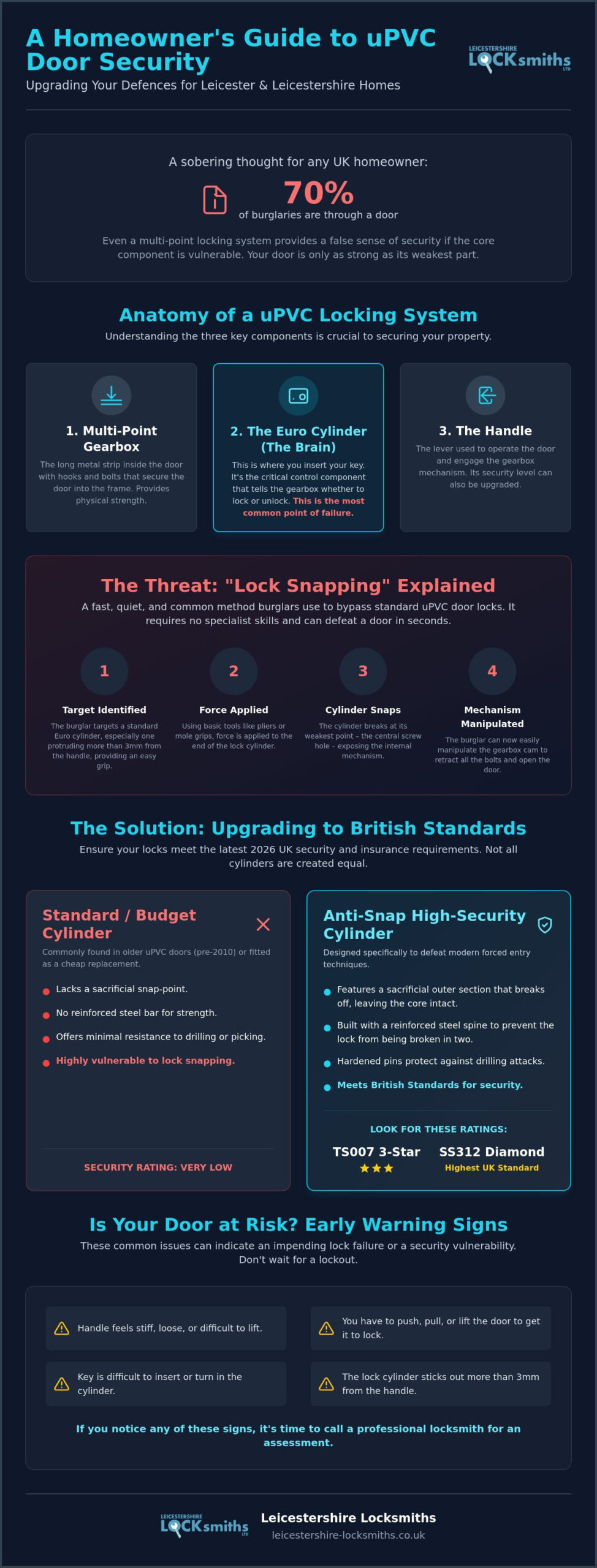
The Euro cylinder is the heart of your home’s entry points. It is the barrel-shaped component where you insert your key, and it acts as the “brain” of your door’s entire locking system. Many homeowners in Leicester ask us, are uPVC door locks secure? The answer depends almost entirely on this one small piece of metal. Whilst your door frame might be reinforced with galvanised steel, the Euro Cylinder lock mechanism is often the primary target for intruders because it controls everything else.
To understand your security, you must distinguish between three different parts: the handle, the cylinder, and the internal multi-point gearbox. The handle is simply the lever you use to operate the door. The gearbox is the long strip of metal inside the door that moves the bolts. The cylinder is the guard that tells the gearbox when it is allowed to move. If a burglar bypasses the cylinder, they gain direct access to the gearbox, rendering even the strongest door frame useless. If you’re experiencing a stiff handle, it’s often a sign that the gearbox is struggling, which may require professional uPVC door repairs before a total failure occurs.
How uPVC Locking Mechanisms Work
Most modern doors in Leicestershire utilise a “lift-to-lock” behaviour. When you pull the handle upwards, you’re engaging a series of rollers, mushrooms, and hook bolts into the door frame. The rollers provide a tight weather seal, whilst the hooks and mushrooms provide the actual physical security. A multi-point lock is a system that secures the door at multiple points along the jamb. However, these points only stay locked because the Euro cylinder prevents the mechanism from being retracted without the correct key.
The Evolution of uPVC Door Security
Historically, uPVC doors were fitted with basic cylinders that offered very little resistance to forced entry. In the 1990s and early 2000s, the focus was primarily on weatherproofing rather than high-level security. Consequently, older uPVC doors (typically those installed pre-2010) are often fitted with “basic” cylinders that lack modern anti-snap features. Whilst the door itself might look imposing, the real question of are uPVC door locks secure rests on the grade of that internal barrel. Even a brand-new, high-end door is only as safe as the cylinder installed within it. Upgrading to British Standard locks is the most effective way to bring an older door up to modern 2026 security expectations.
The Reality of Lock Snapping: Why Standard uPVC Locks Are Vulnerable
Lock snapping is a method of entry that has become a significant concern for homeowners across Leicestershire. It involves applying physical force to the Euro cylinder until it breaks at its weakest point. When residents ask are uPVC door locks secure, they often assume the multiple bolts and hooks provide ultimate protection. However, if the cylinder is a budget model, those hooks are easily bypassed. Once the cylinder snaps, the internal gearbox becomes exposed, allowing an intruder to open the door in seconds using basic household tools.
The fundamental flaw lies in the central cam of the cylinder. This is the narrowest part of the lock, where the screw hole is located. In standard or budget cylinders, this area lacks reinforcement. Burglars simply grab the end of the lock and apply enough torque to snap the metal. Because this happens inside the door, the multi-point locking system remains completely intact but totally ineffective. It is vital to ensure your hardware meets Police-preferred security standards to prevent this specific attack.
Another common issue we encounter is the “protruding cylinder” error. This occurs when a lock is incorrectly sized and sticks out too far from the door handle. If more than 3mm of the cylinder is visible, it gives an intruder a perfect surface to grip with pliers. If you notice your lock is protruding or if you are worried about your current security levels, you can arrange a professional security upgrade to identify these hidden risks.
The 10-Second Vulnerability
Speed is the burglar’s greatest ally. A snap attack on a non-rated lock requires no specialist training and very few tools. It is a preferred method because it is relatively quiet compared to smashing glass or kicking in a door. We find that uPVC door repairs in Leicester often involve attending properties where the cylinder has been snapped, leaving the residents shocked at how quickly their home was accessed.
Common Signs Your uPVC Lock Is at Risk
You don’t need to be an expert to spot potential weaknesses. Check your doors for these red flags:
- Visible brand names on the cylinder that lack a Kitemark or star rating symbol.
- A lock cylinder that sits more than 3mm proud of the handle surface.
- A handle that feels loose or “wobbly,” which often suggests the internal components are wearing down.
- Difficulty inserting the key or a “gritty” feeling when turning the lock.
If you identify any of these signs, it’s worth considering whether your current setup is truly safe. Knowing the answer to are uPVC door locks secure in your specific case depends on addressing these visible vulnerabilities before they are exploited.
British Standards Explained: TS007 3-Star and SS312 Diamond
Navigating the technical specifications of home security can feel overwhelming, but understanding these codes is the only way to verify if your home is truly protected. When evaluating whether are uPVC door locks secure, you must look beyond the appearance of the door and focus on the technical certifications. The answer is found in the small symbols etched into the metal of your lock. The TS007 Kitemark is the industry benchmark, using a star rating system to indicate how much physical punishment a lock can withstand before failing.
To achieve what we call a “3-star solution,” you have two main choices. You can install a 3-star rated cylinder, which provides complete standalone protection against all known attack methods. Alternatively, you can combine a 1-star cylinder with a 2-star security handle. Both methods meet the rigorous requirements often set by UK insurance providers. Upgrading to British Standard locks ensures that your property complies with modern 2026 safety expectations and helps avoid issues during an insurance claim.
TS007 1-Star vs. 3-Star Cylinders
A 1-star cylinder offers a baseline of security but lacks the reinforced bridge necessary to stop a snap attack on its own. It requires the physical shielding of a reinforced handle to be effective. In contrast, a 3-star cylinder is the gold standard for Leicester homeowners. It is engineered with internal sacrificial “snap lines.” If an intruder tries to break the lock, the outer section breaks off, leaving the vital locking mechanism deep inside the door where it cannot be reached. These cylinders also feature hardened steel pins to resist drilling and complex internal configurations to stop picking and bumping.
Identifying the Kitemark on Your Door
You can usually check your own security levels in seconds. Open your door and look at the narrow face of the lock cylinder where the key enters. You should see the British Standard heart-shaped Kitemark symbol. Directly above or below this symbol, you’ll find the star rating. If there are no stars, or only one, your security is likely outdated. The SS312 Diamond rating is a separate, equally prestigious accolade from the Master Locksmiths Association specifically designed to combat the most advanced snapping techniques. If your lock carries either a TS007 3-star or an SS312 Diamond mark, you can feel confident that your home is equipped with the best available protection when people ask are uPVC door locks secure.
Beyond the Cylinder: Strengthening Your uPVC Door Defences
While the 3-star cylinder is the priority, it isn’t the only way to bolster your home against intruders. A comprehensive approach considers the entire door assembly. When evaluating are uPVC door locks secure, you must also inspect the handle set and the door’s physical orientation. A reinforced handle can prevent a burglar from ever reaching the cylinder in the first place, acting as a robust outer shell for your security system.
Security Handles and Cylinder Guards
High-security handles, often 2-star rated, are designed with a reinforced backplate and integrated cylinder guards. These components ensure that an intruder cannot use pliers or mole grips to grab the lock barrel. Beyond the physical protection, they serve as a powerful visual deterrent. A burglar looking for an easy target will often bypass a home that features chunky, solid-looking security hardware. Just remember that compatibility is key; you must ensure the new handle matches your existing multi-point screw centres, which are typically 92mm or 62mm in Leicestershire homes.
Sash Jammers: An Extra Layer of Protection
These simple devices are excellent for patio door security and are equally effective on uPVC windows. They provide a physical stop that prevents the door leaf from being forced open, even if the primary lock is compromised. They are particularly useful for older doors that may have slightly weaker frames. To avoid voiding your uPVC warranty, these should be fitted into the internal steel reinforcement of the frame. They offer great peace of mind whilst you are away on holiday or during the night.
For outward-opening doors, hinge bolts or dog bolts are essential. If your door opens towards the garden, the hinges are exposed on the outside. Intruders could potentially cut these hinges to remove the door entirely. Hinge bolts stay hidden when the door is closed, locking the leaf into the frame and preventing it from being lifted out. Determining if are uPVC door locks secure also involves checking your glazing beads. If they are on the outside of the door, an intruder can simply pop the beads off and remove the glass unit. Modern security standards demand internal glazing to eliminate this risk.
If you’re unsure about your door’s secondary defences, you can book a professional security survey to identify these weak spots and ensure every entry point is properly hardened.
Maintaining Your uPVC Security: When to Call a Leicester Locksmith
Maintaining your uPVC door is just as important as the lock you choose. You might have the best 3-star cylinder in the world, but if the door itself is out of alignment, the entire mechanism is under constant strain. Many homeowners ask us, are uPVC door locks secure if the door is difficult to close? The reality is that a misaligned door is a significant vulnerability. It forces the internal gearbox to work much harder than intended, which eventually leads to metal fatigue and a total mechanical failure.
Instead of attempting a DIY fix, a professional security upgrade or service is usually a far better investment. Modern uPVC mechanisms are complex systems. A single misplaced screw or a poorly adjusted hinge can prevent the hooks from engaging properly, leaving your home at risk. We often see homeowners across Leicester who have tried to “force” a stiff handle, only to find themselves stuck outside. When the internal gearbox shatters, it often happens while the door is locked, making the subsequent repair far more complicated and expensive.
Warning Signs of a Failing uPVC Mechanism
Your door will usually provide several warnings before it fails completely. You should pay close attention to these common symptoms:
- The handle is noticeably difficult to lift or does not spring back to a horizontal position.
- The key feels “spongy” or requires significant physical pressure to turn inside the cylinder.
- You hear clicking, grinding, or snapping sounds when operating the handle or the key.
- The door needs to be “pushed” or “pulled” with force to get the bolts to line up with the frame.
Why Local Expertise Matters in Leicestershire
Leicester features a diverse range of housing stock. From the Victorian terraces in Knighton and Aylestone to the modern residential estates in Hamilton and Oadby, every door presents a different challenge. A local expert understands the specific brands of hardware common in Leicestershire homes and carries the correct parts to fix them on the first visit. This local knowledge is vital for emergency door opening services; we know exactly how to bypass a failed mechanism without damaging your door leaf or frame.
Whether you are in Birstall, Braunstone, or the city centre, keeping your home safe is about proactive maintenance. Professional locksmiths ensure that every component, from the hinges to the hooks, meets the latest UK insurance requirements. This gives you the ultimate answer to the question: are uPVC door locks secure? They are, provided they are maintained by a professional who knows exactly how they operate.
Take Control of Your Home Security
Home security in 2026 is about more than just having a locking door; it’s about ensuring every component meets current British Standards to protect your property and satisfy insurance requirements. We have explored how the right cylinder and secondary defences can transform your safety. Ultimately, the question of are uPVC door locks secure comes down to the quality of the hardware and the expertise of the person fitting it. Upgrading your entry points is a straightforward process that provides immediate protection against the vulnerabilities common in older installations.
Whether you require immediate emergency locksmith services for a lockout or are planning comprehensive lock changes, our team is here to help. We specialise in high-quality uPVC door repairs and bespoke commercial locksmith work for businesses across the county. Our focus on non-destructive entry and high-standard hardware ensures your property remains protected without unnecessary fuss or damage. To secure your property today, contact Leicestershire Locksmiths for a professional uPVC security audit. We are dedicated to keeping Leicestershire homes and businesses safe with reliable, local expertise you can trust.
Frequently Asked Questions
Are uPVC doors easy to break into?
A uPVC door is only as secure as the cylinder installed within it. If your door is fitted with a standard, non-rated Euro cylinder, an intruder can use a technique called lock snapping to gain entry in under ten seconds. However, when residents ask are uPVC door locks secure, the answer is a firm yes if the door features modern anti-snap technology and a correctly adjusted multi-point locking system.
What is the best lock for a uPVC door in 2026?
The current industry gold standard is a TS007 3-star Kitemarked cylinder or an SS312 Diamond rated lock. These specific cylinders are engineered to withstand the most common forced entry methods, including snapping, drilling, and picking. Choosing a lock with these certifications ensures your home meets the highest possible security criteria for modern residential properties.
Can I put a deadlock on a uPVC door?
You cannot install a traditional mortice deadlock into a uPVC door because the internal hollow frame and multi-point mechanism don’t have the space for it. Instead, the multi-point locking system acts as a series of deadbolts by engaging multiple hooks into the frame. For those seeking extra physical protection, sash jammers or high-security handles are the most effective secondary additions.
How do I know if my uPVC door lock is anti-snap?
Check the face of the cylinder where you insert your key for the British Standard Kitemark symbol. A truly anti-snap lock will typically have three stars stamped above that heart-shaped Kitemark. If you see no stars or only a single star, your lock lacks integrated anti-snap protection and may require a security handle to be fully compliant with modern safety expectations.
Do I need to replace the whole door if the lock is broken?
You almost never need to replace the entire door leaf or frame if the lock or internal mechanism fails. Most components, including the Euro cylinder and the long multi-point gearbox, are modular parts that a professional can replace individually. This is a far more cost-effective solution than a full door replacement and usually restores your security in a single visit.
How much does it cost to upgrade uPVC door locks in Leicester?
The investment required to upgrade your security depends on the grade of the hardware you choose and the specific dimensions of your door. High-security 3-star cylinders involve more complex engineering than basic models, which is reflected in the price. It is always best to speak with a local expert who can provide an accurate quote based on your specific requirements and door type.
Can I change a uPVC door lock myself?
Whilst it is possible to swap a cylinder yourself, it carries significant risks if you aren’t experienced. Incorrectly measuring the lock can leave it protruding from the handle, which makes it an easy target for snapping attacks. A professional locksmith ensures the lock is sized perfectly and checks that the multi-point mechanism is correctly aligned to prevent future mechanical failures.
Will upgrading my locks lower my home insurance premium?
Upgrading your hardware might not always result in a lower monthly premium, but it is often essential for maintaining your cover. Most UK insurers now mandate that uPVC doors are fitted with Kitemarked cylinders that meet specific British Standards. If your locks are outdated and a break-in occurs, your insurance provider could potentially refuse to pay out your claim. Ensuring you can answer “yes” when asked are uPVC door locks secure is vital for your financial protection.